


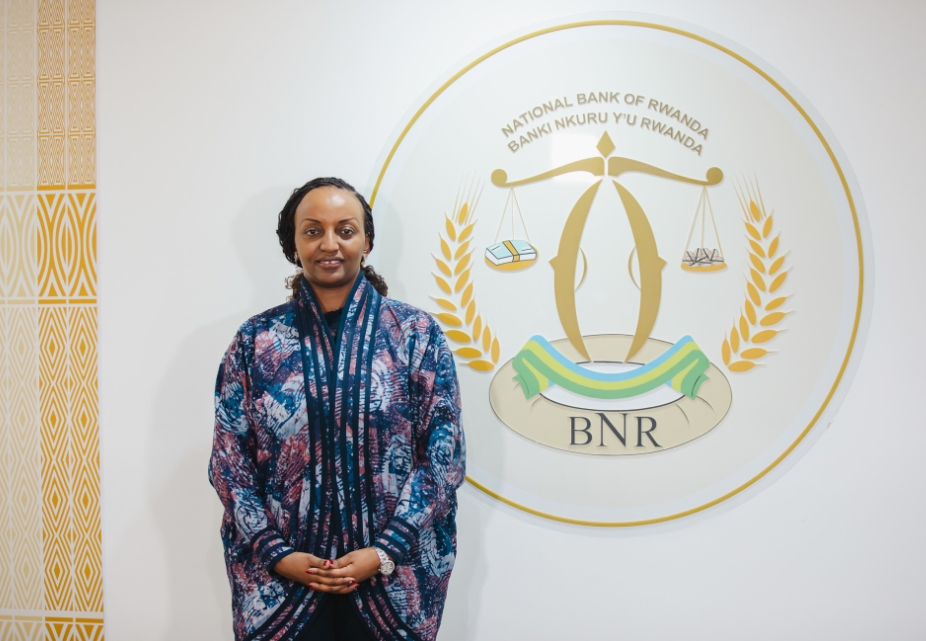
After John Rwangombwa finished his two-year term that started in 2013, President Paul Kagame named Soraya Hakuziyaremye as the National Bank of Rwanda (BNR)’s first female governor on February 25.
Before being appointed as the bank’s top leader, Hakuziyaremye served as deputy governor for almost four years, putting her in a strong position to carry out the bank’s mandate of preserving Rwanda’s financial stability.
BNR was run by male governors until Hakuziyaremye was appointed. The bank was founded in 1964.
She listed her top priorities in an exclusive interview with The New Times on February 27, emphasizing improving price stability, encouraging financial inclusion, and overcoming the difficulties brought on by inflation and the depreciation of the Rwandan franc.
As the incoming governor of the central bank, what will be your top priorities?
Making ensuring there is continuity is the first step. Our responsibility as a central bank is to uphold the stability of the financial system and prices. That is the primary goal since we can discuss economic growth only once pricing and financial stability have been established. Without macroeconomic stability, an economy cannot expand.
However, we have expanded our purpose to include encouraging inclusive and sustainable growth. I’ve always been passionate about financial inclusion: how can we ensure that all Rwandans can take advantage of financial services as our financial sector grows?
In terms of individuals having access to bank accounts, mobile money accounts, and what we refer to as basic financial services, we’ve made significant strides.
However, I believe that as a nation, we must do more. How can we help our people become more financially resilient so that they can save, invest, and make long-term plans in addition to having a bank account?
Our nation should strive to have a populace or citizens that value wealth development; we should make money for our kids and grandkids.
The central bank’s digital transformation was the last project we began working on, even in my prior role as deputy governor. As you are aware, technology has a significant impact on finance, and more services are now available online.
Last but not least, we are aware that the Kigali International Financial Center was founded. Therefore, I believe that my top priority is to help our International Financial Center grow by attracting more players to our nation in various sectors and ensuring that the central bank makes a significant contribution to the expansion of our stock and capital markets, as these are the cornerstones of a true International Financial Center.
I am aware that we have already taken certain steps to strengthen the foundation that departing Governor John Rwangombwa established. In the next five to six years, I’m rather certain that we’ll also be successful.
High inflation and the Rwandan franc’s depreciation are two of the lingering issues. How will price stability be restored?
Indeed, the past three years have been difficult for Rwanda and the rest of the world due to rising inflation rates, particularly in 2022 and 2023. However, when you consider how we were able to keep inflation under control last year, we had an annual rate of 4.2%, which is actually within our range, which is between 2% and 8%.
In my opinion, inflation rates have returned to normal.
Using our monetary policy tools and collaborating with other stakeholders, we are estimating that we will be close to the 6.5% predicted for 2025 in 2025 and 2026.
The exchange rate has been under pressure due to depreciation, but we are aware of the cause. We’ve seen a structural trade imbalance, which means that we import more than we export, but that’s to be anticipated in a rapidly developing nation. We require a lot of imports for our development, particularly in the manufacturing sector, where we need raw materials and machinery.
However, the government has taken steps and implemented plans to ensure that we can boost exports with a new industrial policy and export strategy for Rwanda. Therefore, we’re collaborating closely with all important parties to ensure that we can reduce that trade deficit, which will stabilize our currency.
However, we are also advocating for increased investment in the nation. That will be beneficial as well. Therefore, the pressures we had on our currency in 2023, when it depreciated by 18% [against the US dollar], decreased to 9% last year. We have cut it in half.
It’s a positive trend, but I’m not saying it’s good news. In the medium run, we should return to the levels of depreciation that we had previously seen, which is about 5%. This is what we believe to be healthy for the current economy.
In the larger framework of women’s leadership in finance and governance, what does it mean to you to be the first female governor of a central bank?
It’s always brought up, I believe, when you’re the first woman to manage an organization. In my opinion, it is a privilege and an honor, but it is also a result of the policies our nation has implemented and the conscious efforts made to ensure equal opportunities for men and women in Rwanda.
I am also aware that it is the outcome of numerous other women who have demonstrated their ability to perform the job while working in other industries, primarily the central bank. People might still have doubts about a woman’s ability to not just work as a central banker but also likely run one if they hadn’t taken this action. Although I am really appreciative of the chance, I also have expectations for my performance going forward, and I’m certain that I won’t be the last female central banker.
It makes me appreciate that chance and the people who came before me. They cleared the path because, as you are aware, we had two female deputy governors prior to that.
In addition to leading Rwanda’s central bank, I hope to be setting the path for many more women to hold leadership positions in other organizations, particularly in the financial sector.