


The New Times examines a seemingly tense relationship between the M23 Movement and SADC troops in regions under M23 control in the third installment of our “Stories from Goma” series. Troops from South Africa, Tanzania, and Malawi make up the SADC mission, which was sent out more than a year ago.
Over half of them are thought to be from the South African National Defence Force (SANDF), and their estimated strength exceeds 4000.
According to a SADC statement issued at the time, troops under the SADC mission, known as SAMIDRC, started to arrive in Goma, the capital of North Kivu province, which is currently under M23 control, in December 2023 with the purpose of assisting the DR Congo army “in fighting armed groups operating in the Eastern DRC.”
The deployment was approved “in accordance with the SADC Mutual Defense Pact’s principle of collective self-defense and collective action.” A clause that states that “any armed attack perpetrated against one of the States Parties shall be considered a threat to regional peace and security and shall be met with immediate collective action” was specifically mentioned by SADC leaders.
However, there were two main issues.
According to witnesses, the M23 is made up of Congolese citizens who have justifiable complaints about the persecution of their communities. Some of these individuals are Kinyarwanda Congolese, who claim they have been singled out because of their ancestry’s ties to Rwanda. This is true even though their native home is in the eastern Congo.
The argument is that the SADC clause meant that a foreign actor had breached a SADC member state’s territorial integrity, and as a result, the other countries were just carrying out their mutual support duty.
Their deployment came after the East African Community Regional Force (EACRF) was dismissed by President Felix Tshisekedi of the Democratic Republic of the Congo for refusing to take sides in the conflict and instead insisting on carrying out its mandate as a neutral force. M23 had retreated from 80% of the area it controlled before EACRF’s deployment in November 2022, despite having a significantly smaller territory at that time.
The EAC’s attempts to find a long-term solution under former Kenyan leader Uhuru Kenyatta, however, were destroyed by its expulsion and subsequent withdrawal amid attacks on M23 positions by Congolese forces and their allies, including the Wazalendo militia group and the genocidal FDLR group with roots in the 1994 Genocide against the Tutsi in Rwanda.
The peacekeeping force of OUT EAC.
The offensive fighting force of SADC.
SAMIDRC wasted no time. They sprung into action right away after arriving with heavy weapons.
They were stationed at Goma airport, Mubambiro (in Masisi), and Kibati (in Nyiragongo), among other locations and along several axes.
SAMIDRC launched their first significant offensive against M23 in May 2024, in the hills above Sake and Mubambiro in Masisi area.
M23 destroyed five SAMIDRC tanks and captured two more during the operation, which was code-named “Caterpillar I.” The South African troops fled far from their camp. During our visit earlier this week, the M23 officer with the title of Major informed us, “They believed we were pursuing them, but we weren’t; we only engaged artillery weapons as they fled all the way to Mugunga (about 18km from Sake on the way to Goma).”
The same M23 officer would lead the unit that took control of Mubambiro barracks when M23 began their swift march against Goma last month, but this is obviously one version of events that is difficult to confirm.
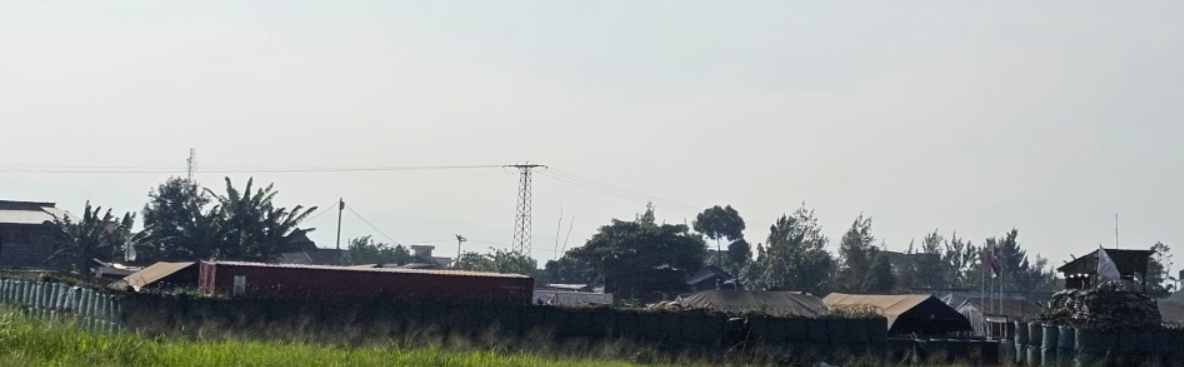
Although M23 now controls Mubambiro Barracks, South African troops and the other SADC contingents are still stationed at the site, maintaining their weapons while flying white flags from their bases.
White flags are used in the military to signify surrender, ceasefire, or a desire to negotiate; hence, soldiers that fly them are not to be shot upon because they do not plan to attack and instead wish to engage in peaceful communication with the other side.
Similar to Goma airport, SADC forces are limited to their respective camps here at Mubambiro, and only M23 has the authority to permit any movement. The M2 commander at Mubambiro informed us that they must inform us of whatever they wish to perform or when they would need anything supplied to them.
We get their messages in writing, he said.
Some of the letters sent to the corresponding M23 commanding officers by SADC troops stationed at Goma and Mubambiro airports were published in the New Times.
Every contingent has direct communication with M23 officers, and their memos provide M23 commanders with detailed information, such as start and destination locations, and range from requests for the passage of food and other supplies to the transit of private contractors to sewage removals.
“We help them as best we can. Before choosing to hire contractors to handle the delivery, the South African team was permitted to gather goods from their main base in Goma four times, according to the M23 officer.
When asked if they had ever refused requests from the SAMIDRC contingents, he replied, “Only a few occasions, maybe once or twice. In one case, one of the contingents was asking to transfer their colleagues from Goma airport and bring them to Mubambiro, and we told them that we could give that permission, movement of troops can only be authorized by the higher authorities.” He identified the contingent in question. “The other,” he said, “is when the South Africans asked to collect their weapons and ammunitions they abandoned outside when they faced us on the day we took this barracks. That one we rejected.” He then showed us the firearms and ammunition in question.
However, he asserted that most of the requests were granted. “They are not at fault for being here; we treat them with kindness.” We even supply them with water.
“Request for passage of contractors” was the heading of a letter written in February 2025 by Lt Col M Sello, Second in Command of the South African SAMIDRC force. It reads: “The RSACONT hereby requests the safe passage of Bread and Bakery delivery on daily basis from Goma to Sake from the Ble D’Or supplier.”
He added, “For your immediate attention and kind response,” and gave the driver’s name.
The letters are written to “Col Augustine (M23 Military)” at Mubambiro, and copies of them have been viewed by The New Times.
On January 30, 2025, one of them asked for permission to send a group of 15 soldiers to Mubambiro to look for the bodies of dead comrades.
The SADC contingent apologizes
The SAMIDRC contingents at Goma airport follow the similar procedure.
But compared to Mubambiro, the relationship between M23 and the SADC troops here seems more strained. An M23 Major who headed the team that took control of Goma airport during intense combat on February 28 told The New Times on Monday, “Some of them have tried to do things without our knowledge but we’ve made clear that’s unacceptable.”
In one instance, the driver of a United Nations vehicle that was transporting supplies to the South African outpost on February 7 “behaved badly.” A letter of apology was later sent by the South African contingent.
Part of the text reads, “Today we received a phone call from QRF 2IC (Quick Reaction Force Second in Command) informing us that the driver of the UN vehicle that delivered rations behaved badly towards the members of M23 when he was stopped from entering the airport gate and nearly injured the M23 soldiers.”
“We sincerely apologize for the driver’s behavior, as we were unaware of that incident,” the letter, dated February 8, 2024, continued. We will let the driver know that he must follow instructions when they are given to him.
“I acknowledge that all movements will be coordinated through QRF 2IC as directed and I apologise for the unfortunate movement which occurred yesterday without your knowledge,” the letter’s author, Lt Col A. Phamodi of the SAMIDRC Joint Task Force, continued.
The UN peacekeeping force stationed at the airport was partially held accountable by the M23 commander for encouraging these “unacceptable acts.”
White-flag events
One of the SADC contingents had down their white flags, a soldier informed the M23 Major as we were interacting with him at his airfield base.
He said, clearly surprised, “Is it? That’s okay; I’ll go ask them whether they’re prepared to fight in the morning.
In fact, the officer stopped briefly at the SADC contingent in question and summoned one of the uniformed guards at the door as we were leaving his headquarters to begin our tour of the airport.
In Swahili, he said, “We askari, njoo hapa,” which translates to “soldier, come here.” The soldier approached and saluted with clinched hands. He said to him, “I see you’ve taken down the white flags. Please go ask your boss if you’re ready to fight tomorrow morning.”
“Yes, sir,” was the soldier’s response.
The M23 commander called him about half an hour later to inform him that the white flags were flying high once more as he was showing us the different weaponry and other equipment that the government soldiers and their allies had left behind.
I questioned him about his thoughts on the matter. “The basic fact is that this is our area, and SADC forces are not welcome here. These soldiers should be in their countries performing their constitutional duties, and they should be assisted in securely returning home. They are in the wrong place; I don’t understand why any foreigner should become engaged in this Congolese strife.
There is ambiguity about what will happen to the soldiers who are still in M23-held area, despite the fact that at least 14 dead and injured SAMIDRC soldiers were repatriated on Friday of last week.
Lazarus Chakwera, the president of Malawi, issued an order earlier this month directing his forces to begin making withdrawal preparations from the Democratic Republic of the Congo.
It’s unclear, though, if any progress has been made in that regard.
Additionally, despite the conclusions of the joint EAC-SADC summit earlier this month in Dar es Salaam, Tanzania, which called for peace negotiations between Kinshasa and M23, there have been allegations that South Africa was considering sending more troops to DR Congo.